\(\) QEDのブログ記事を書く際に, W.Greiner: RELATIVISTIC QUANTUM MECHANICS wave equations を利用している.この本はシリーズ化されており, 日本語化されているのは第1巻の「量子力学概論」と第9巻の「熱力学・統計力学」の2冊だけらしい.そこで「量子力学概論」を入手して読み始めたのだが, 最初の第1章で早速つまずいてしまった.§ 1.3 コンプトン効果 では訳者による補足がなされているらしいので, 原文を載せておくことにする.
1.3 The Compton Effect
When X-rays are scattered by electrons, a shift in frequency can be observed, the amount of this shift depending on the scattering angle. This effect was discovered by Compton in 1923 and explained on the basis of the photon picture simultaneously by Compton himself and Debye.Figure 1.3 illustrates the kinematical situation. We assume the electron is unbound and at rest before the collision. Then the conservation of energy and momentum reads: \begin{align*} \hbar\omega &= \hbar\omega’ + \frac{m_0 c^{2}}{\sqrt{1-\beta^{2}}}\ -\ m_0 c^{2}, \tag{1.6}\\
\hbar\boldsymbol{k} &= \hbar\boldsymbol{k}’ + \frac{m_0\boldsymbol{v}}{\sqrt{1-\beta^{2}}}. \tag{1.7} \end{align*}
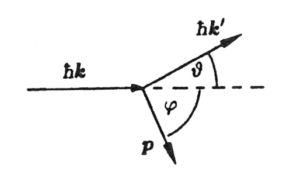
Fig. 1.3 Conservation of momentum in Compton scattering
This yields, with \(k=\omega/c\), \begin{align*} \frac{\hbar\omega}{c} &= \frac{\hbar\omega’}{c} \cos\theta + \frac{m_0 v}{\sqrt{1-\beta^{2}}}\cos\phi \qquad \text{and} \tag{1.8}\\ \frac{\hbar\omega’}{c}\sin\theta &= \frac{m_0 v}{\sqrt{1-\beta^{2}}}\sin\phi. \tag{1.9} \end{align*} From these two component equations, we can first eliminate \(\phi\) and then, by (1.6), the electron velocity \(v\) (\(\beta = v/c\)). Hence for the frequency difference we have \begin{align*} \omega\, -\, \omega’ = \frac{2\hbar}{m_0 c^{2}} \omega\,\omega’ \sin^{2} \frac{\theta}{2}. \tag{1.10} \end{align*} If we put \(\omega=2\pi c/\lambda\), we obtain the Compton scattering formula in the usual form with the difference in wavelength as a function of the scattering angle \(\theta\) : \begin{align*} \lambda’ \, -\,\lambda = 4\pi \frac{\hbar}{m_0 c} \sin^{2} \frac{\theta}{2}\tag{1.11} \end{align*} The scattering formula shows that the change in wavelength depends only on the scattering angle \(\theta\). During the collision the photon loses a part of its energy and the wavelength increases \((\lambda’ > \lambda)\).
The factor \(2\pi\hbar/m_0 c\) is called the Compton wavelength \(\lambda_c\) of a particle with rest mass \(m_0\) (here, an electron). The Compton wavelength can be used as a measure of the size of a particle. The kinetic energy of the scattered electron is then
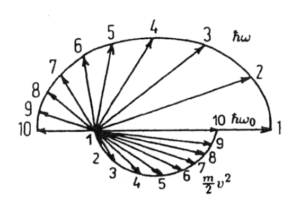
Fig. 1.4 The Compton effect energy distribution of photons and electrons, showing dependence on the scattering angle
Thus the energy of the scattered electron is directly proportional to the energy of the photon. Therefore the Compton effect can only be observed in the domain of short wavelengths (X-rays and \(\gamma\)-rays). To appreciate this observation fully, we have to remember that in classical electrodynamics, no alteration in frequency is permitted in the scattering of electromagnetic waves; only light quanta with momentum \(\hbar\boldsymbol{k}\) and energy \(\hbar\omega\) make this possible. Thus the idea of light quanta has been experimentally confirmed by the Compton effect. A relatively broad Compton line appears in the experiment, due to certain momentum distributions of the electrons and because the electrons are bound in atoms.
The Compton effect is a further proof for the concept of photons and for the validity of momentum and energy conservation in interaction processes between light and matter.
コンプトン散乱については教養物理で学ぶ内容と思うが, 改めて学習し直しておこう.学生時代の参考書:A.P.アーヤ「基礎現代物理学」の§ 2.7 を抜粋したPDFファイルを載せておく.